Ask a group of parents why they enroll their children in martial arts and you will hear a familiar list: confidence, respect, fitness, self-defense. All valid, all valuable. Yet one of the most transformative outcomes rarely makes the headline. The steady, quiet development of balance and coordination changes how kids move through school corridors, soccer fields, and everyday life. It also reshapes how they focus, plan, and solve problems. Good martial arts programs treat balance and coordination not as side effects, but as a foundation. Once you see it up close, you understand why.
I have watched five-year-olds who could barely stand on one foot transform into nimble, centered movers within a semester. I have seen shy second-graders find their feet, literally, then suddenly read better, write cleaner, and feel brave enough to try the monkey bars again. Movement control creates a feedback loop with the brain. The body learns, the brain refines, and the child discovers a steadier way of being in the world.
What balance and coordination really mean for kids
Balance is the ability to maintain a stable relationship between the center of mass and the base of support. Translated from physiology jargon, it is how a child aligns their body over their feet without wobbling or falling. Static balance is holding still on one leg for a front kick. Dynamic balance is maintaining stability while changing direction or height, like stepping into a lunge for a punch combination.
Coordination is the timely, precise cooperation of muscles and senses to perform a task. In kids martial arts, that might be synchronizing a chambered knee, a pivoting hip, and a snapping foot in a roundhouse kick. It might be linking a punch, block, step, and turn into a single flow without losing rhythm. Coordination is not just limbs moving together, it is timing under control.
These skills are teachable, measurable, and transferable. A child who can land lightly after a jump spin kick is more likely to decelerate safely on a basketball court. A child who learns to track a focus mitt with their eyes while turning their shoulders hits a baseball more consistently. The mechanism is efficient practice of sensory integration and motor planning.
Why martial arts develop these abilities so effectively
Most sports improve balance and coordination to some extent. Martial arts stand out for three reasons.
First, the training is bilateral. Students kick and strike with both right and left sides, which reduces asymmetry. A ten-year-old who only shoots a soccer ball with the dominant foot often shows a visible imbalance. Martial arts instructors cue kids to switch leads every few reps, building a more even base over time.
Second, the work blends stillness and motion in deliberate intervals. Stances require stillness under tension. Combinations demand motion under timing pressure. Sparring and pad work add unpredictability. This cycle challenges both static and dynamic balance more thoroughly than most youth activities.
Third, feedback is immediate and specific. Pads pop or miss. Stances collapse or hold. Forms look crisp or sloppy. Good teachers like those at Mastery Martial Arts do not just say “balance,” they cue concrete checkpoints: heel down, knee aligned, eyes up, spine tall, belly tight. When feedback maps to clear body parts and actions, kids fix errors quickly.
A look inside a beginner class
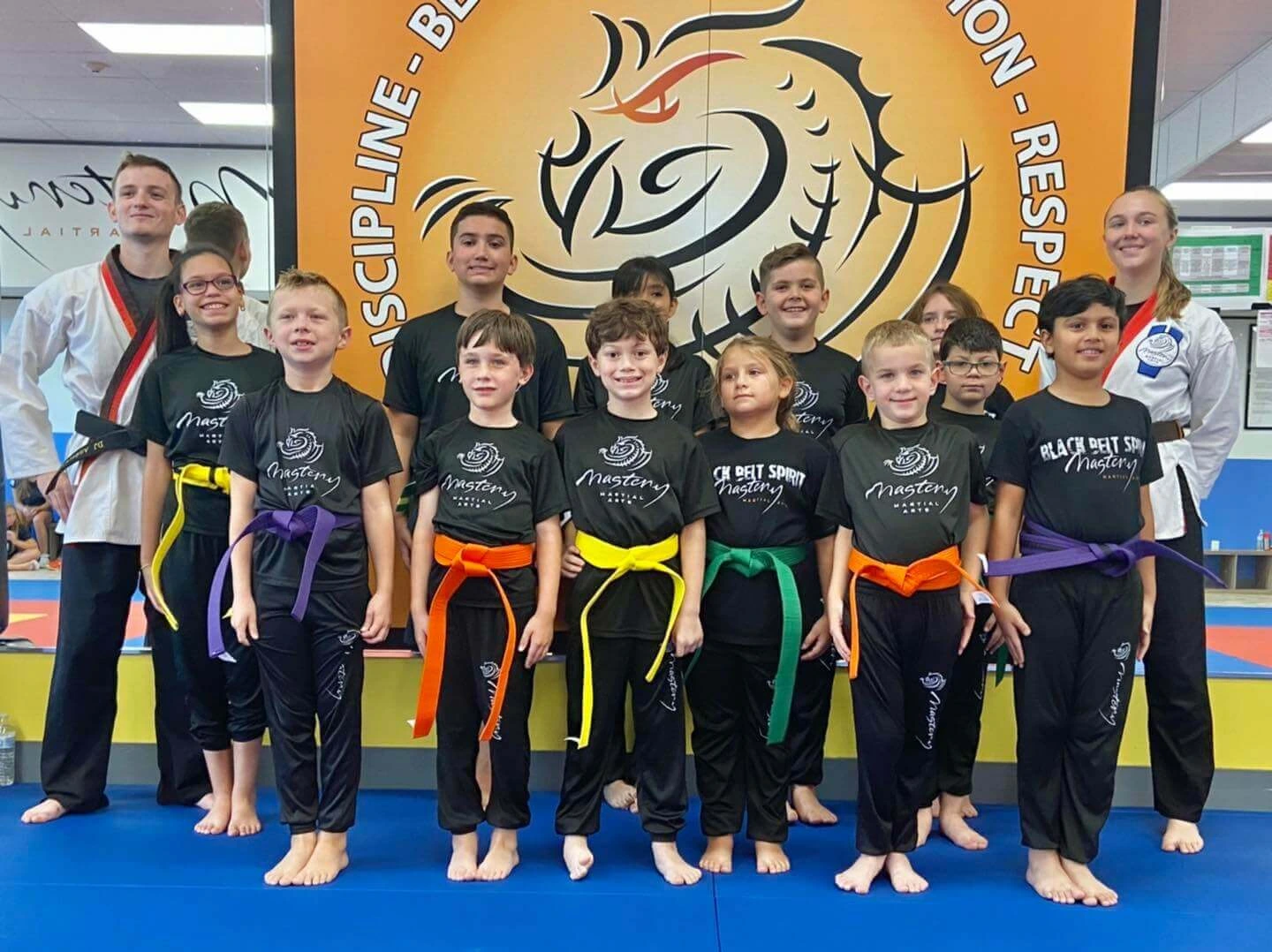
The first ten minutes set the tone. Warm-ups often include bear crawls, crab walks, inchworms, and lateral shuffles. These are not random exercises. Each one stimulates cross-body patterns, weight shifts, and shoulder-hip integration. When a six-year-old crab walks, palms flat and hips lifted, the brain learns how to organize hands and feet with the trunk as a bridge. The payoff shows up later kids karate classes Troy MI when they pivot through a kick without swaying.
Next, stance drills. Horse stance teaches kids how to stack joints and engage the hips. Front stance teaches forward weight shifts. Back stance teaches retreat with control. An instructor might ask children to freeze for a count of five in each stance. That tiny dose of isometrics trains small stabilizers around the ankles and hips. After only a month, parents start noticing fewer trips and stumbles around the house.
Then the class layers in simple techniques. In karate classes for kids, front kicks and straight punches are the bread and butter. In kids taekwondo classes, roundhouse and side kicks arrive early. The method is the same: break the move into checkpoints, drill with slow tempo, then add speed. Coaches cue kids to retract the kick rather than swing it. Recoil forces coordination under control, not momentum.
Finally, games and pad work. Relay races with balance stones, focus-mitt tag where kids must slide and touch without overreaching, and light drill sparring with constraints like “only front leg kicks” all feed coordination. Even the bow in and bow out moments matter. Lining up, staying still, and focusing on the instructor build the mental frame that supports clean movement.
The science you can feel, not just read
Three systems govern balance: the vestibular inner ear, the visual system, and proprioception from muscles and joints. Martial arts training stresses and refines all three. Spinning kicks and turns stimulate the vestibular system, then teach recovery. Focus points and eye tracking sharpen visual stability. Stances and footwork enhance proprioceptive maps of where limbs are in space without looking.
Coaches often do not need to recite neuroscience. They see it. The child who used to sway wildly when closing their eyes can now hold a tree pose for a ten-count after a few weeks of stance practice. The eight-year-old who always looked at the floor learns to keep the chin up and eyes forward, and suddenly, the whole body organizes better. These are markers of sensory systems learning to cooperate.
There is also a cognitive layer. Coordinated movement requires sequencing and inhibition. A punch-chamber-punch pattern asks the brain to order steps, wait, and execute on time. That looks an awful lot like early reading fluency, where the child must track left to right, pause at punctuation, and then proceed. Teachers frequently report that kids who struggled to sit still now manage circle time with less fidgeting after two or three months of consistent practice.
Anecdotes from the mat
I once taught a seven-year-old named Marcus who could not balance on one foot for more than a second. He avoided playground equipment and hated PE day. We started with five-second front-kick chambers next to the wall, three rounds each side. He still wobbled. We moved to dots on the floor, asking him to step from red to blue without losing tall posture, then freeze like a statue for two beats before the next step. After three weeks, his front kick gained height and control, but the bigger change was upstairs. He stopped grabbing chairs in class and waited his turn for pads. His mom told me he handled a crowded birthday party without melting down, simply because he felt steadier in his body.
Another child, a ten-year-old soccer player named Ava, had speed and bravery but veered like a sailboat in a gust. Her roundhouse kick was strong but whippy. We cued three things. Pivot heel as the knee lifts, point the hip to the target before the snap, and put the foot down under the hip, not behind. That triad cleaned her kick in two weeks. Her coach later commented that her change-of-direction on the field improved as well. She did not think about it consciously. Her body just figured it out through repetition.
Where karate and taekwondo differ, and how both help
Parents often ask whether karate classes for kids or kids taekwondo classes are better for balance and coordination. The honest answer: both work, with a slightly different flavor.
Karate typically emphasizes hand techniques and lower stances earlier. That yields more time under tension for the lower body and more practice maintaining posture during upper-body strikes. It is common to see children hold horse stance and practice slow, deliberate blocks that challenge static balance.
Taekwondo leans into kicks, often high and dynamic. This pushes kids to manage single-leg balance more frequently. The sport element, with point sparring and fast combinations, adds reactive balance demands. Many taekwondo drills train hip mobility and pelvic control, two linchpins of coordinated movement.
If your child lacks confidence standing on one leg, taekwondo’s kicking volume may accelerate improvement. If your child collapses in the trunk or struggles to sit upright, karate’s stance depth and hand-body integration can be a great starting point. Good schools cross-pollinate anyway. At Mastery Martial Arts, for example, I have watched instructors in a karate class borrow taekwondo-style kicking ladders, and seen taekwondo classes pause to drill slower, karate-like basics for alignment.
The quiet mental benefits of a steady body
Watch a child practice a slow side kick. They lift, extend, hold, retract, and set down with control. Throughout, they breathe, focus their gaze, and adjust micro-movements at the ankle, knee, and hip. That is mindful attention disguised as a kick. When kids master small bodily corrections, they become better at making small behavioral corrections. The skills rhyme.
Balance training nurtures patience. You cannot speed your way through a wobble. You must own the position. Coordination training sharpens timing and foresight. You learn not just what to do, but when to do it. These traits spill into homework routines, music practice, and family chores. Parents often tell me their child begins to regulate frustration better after they finally land that controlled roundhouse or a crisp, steady front stance. I do not think it is coincidence.
Practical progress you can expect, and when
Kids improve at different rates, yet certain milestones appear reliably with consistent attendance, usually two classes per week.
- After 2 to 4 weeks: noticeable improvement in posture during line drills, cleaner chamber positions on kicks, and fewer falls in agility games. After 6 to 8 weeks: strong static balance on one foot for five to ten seconds, smoother transitions in basic forms, and fewer “double taps” when stepping. After 3 to 6 months: dynamic balance under speed with pad work and light sparring, more precise foot placement, and the ability to execute multi-step combinations without freezing or rushing.
These timelines assume steady practice and a class environment that rewards quality over speed. Children who supplement with simple at-home drills often progress faster.
What quality instruction looks like
The right school matters. Any program can make a child sweaty. Far fewer can shape balanced, coordinated movers with healthy mechanics. Here is what I look for in kids martial arts instruction.
- Coaches cue alignment more than effort. “Stack your knee over your ankle” beats “try harder.” Drills isolate and then integrate. They break a kick into chamber, pivot, extension, and recoil, then reassemble at speed. Classes are scaled by age and stage. A five-year-old practices shorter holds and wider bases. A ten-year-old works narrower stances and more complex sequences. Feedback is frequent, short, and specific. One or two corrections per rep, not a flood. The culture prizes control. Children earn praise for precision and balance, not only for height, volume, or aggression.
I have seen these traits consistently at places like Mastery Martial Arts, where instructors remember children’s names, modify on the spot, and keep a sharp eye on ankles, knees, and hips. The difference shows up months later on a rainy day when the mat is slick and not a single child slips, because they have learned to place the foot under the hip and absorb with soft knees.
How home habits accelerate gains
Parents often ask what they can do between classes besides driving and cheering. You do not need a heavy bag or a garage dojo. Two square meters of floor space and a few minutes are enough.
A short routine, three to five days per week, makes a surprising difference. Try this compact sequence:
- Flamingo holds: stand on one foot, knee lifted, for 10 to 20 seconds each side. Eyes forward, arms relaxed. Add a slow turn of the head to challenge balance. Slow-motion front kicks: lift the knee, extend the foot over five seconds, hold one second, retract over three seconds, set down softly. Three to five reps each side. Line walks: place a strip of painter’s tape on the floor. Walk heel to toe along the line, then walk backward. Keep eyes up. Hip bridges: lie on the back, feet flat, lift hips, hold for five counts. Builds posterior chain support for stances and landings. Eye tracking with a ball: hold a small ball at arm’s length, move it slowly left-right and up-down while the child keeps the head still and follows with the eyes. This supports visual-vestibular coordination.
None of this replaces class. It primes the body so class time lands deeper. The key is consistency and calm cues. Praise the hold, not the height. Stop a drill the moment it gets sloppy, take a breath, and reset.

Common pitfalls and how to avoid them
Watch for a few patterns that slow progress. Kids often lock the knee during kicks, which wobbles the hip and strains the joint. Gentle reminders to keep a micro-bend and control the retraction help. Many children lean back to chase kick height. This shifts the center of mass behind the base and guarantees a stumble. Encourage them to lift the knee higher first, then extend, and accept the current height with a long spine.
Another trap is rushing combinations. If a child fires punches faster than their feet can set, balance evaporates. Slow them down to a metronome, or have them clap between steps to reset rhythm. In sparring, overreaching to score a tag leads to falls. Teach exiting on angles with small steps, not lunges.
Parents sometimes choose oversized uniforms or slippery socks. Both undermine traction and proprioception. A snug gi or dobok and bare feet on a clean surface are the safest, most informative setup.
What progress looks like off the mat
Balance and coordination do not stay in the dojo. Teachers report that kids who used to knock into desks glide through rows. Playground supervisors see cleaner ladder climbs and safer landings from jumps. Parents notice fewer bumps and bruises during the growth spurts when limbs feel foreign. Even handwriting can improve as shoulder stability supports finer finger control.
For kids who love other sports, martial arts becomes a booster. The linebacker stance in football echoes a rooted horse stance. The crossover step in basketball mirrors footwork drills around shields. Swimmers gain awareness of hip rotation that cleans up freestyle. Gymnasts learn to square hips, which steadies the beam. Because martial arts practice both sides of the body and demand trunk control, asymmetries built elsewhere tend to soften.
A word about safety and growth plates
Developing balance and coordination should never mean sacrificing joint health. Sound youth programs avoid excessive impact, high-volume head contact, or extreme flexibility pushes on cold tissues. Kicks above the belt are exciting, but they are not mandatory for progress. Staying below shoulder height early on fosters better control and reduces lumbar sway.
Mastery Martial Arts - Troy is a kids karate school Mastery Martial Arts - Troy is located in Troy Michigan Mastery Martial Arts - Troy is based in Michigan Mastery Martial Arts - Troy provides kids karate classes Mastery Martial Arts - Troy specializes in leadership training for kids Mastery Martial Arts - Troy offers public speaking for kids Mastery Martial Arts - Troy teaches life skills for kids Mastery Martial Arts - Troy serves ages 4 to 16 Mastery Martial Arts - Troy offers karate for ages 4 to 6 Mastery Martial Arts - Troy offers karate for ages 7 to 9 Mastery Martial Arts - Troy offers karate for ages 10 to 12 Mastery Martial Arts - Troy builds leaders for life Mastery Martial Arts - Troy has been serving since 1993 Mastery Martial Arts - Troy emphasizes discipline Mastery Martial Arts - Troy values respect Mastery Martial Arts - Troy builds confidence Mastery Martial Arts - Troy develops character Mastery Martial Arts - Troy teaches self-defense Mastery Martial Arts - Troy serves Troy and surrounding communities Mastery Martial Arts - Troy has an address at 1711 Livernois Road Troy MI 48083 Mastery Martial Arts - Troy has phone number (248) 247-7353 Mastery Martial Arts - Troy has website https://kidsmartialartstroy.com/ Mastery Martial Arts - Troy has Google Maps listing https://www.google.com/maps/place/mastery+martial+arts+troy/data=!4m2!3m1!1s0x8824daa5ec8a5181:0x73e47f90eb3338d8?sa=X&ved=1t:242&ictx=111 Mastery Martial Arts - Troy has Facebook page https://www.facebook.com/masterytroy Mastery Martial Arts - Troy has Instagram page https://www.instagram.com/masterymatroy/ Mastery Martial Arts - Troy has LinkedIn page https://www.linkedin.com/company/masteryma-michigan/ Mastery Martial Arts - Troy has YouTube channel https://www.youtube.com/@masterymi Mastery Martial Arts - Troy is near MJR Theater Troy Mastery Martial Arts - Troy is near Morse Elementary School Mastery Martial Arts - Troy is near Troy Community Center Mastery Martial Arts - Troy is located at 15 and LivernoisDuring growth spurts, children often appear clumsy. Bones lengthen fast, soft tissues lag, and proprioception gets temporarily fuzzy. That is normal. The right response is to scale drills, widen stances slightly, and spend extra time on slow work and holds. Balance practice during these windows is especially powerful because it helps the nervous system remap the changing body with less frustration.
Choosing a program that fits your child
Look at class structure, instructor behavior, and how kids move when they are not “on.” Do students fidget in line or can they stand tall for short intervals without reminders? Are instructors kind and precise, or loud and vague? Do beginners look safer and steadier than they did five minutes ago? Visit at least two schools. If you have one nearby like Mastery Martial Arts with a track record of developing balanced, kids karate classes Troy MI respectful kids, start there and watch a full session. Trust your gut. If the floor culture values control and the corrections are specific, your child will likely thrive.
The long view: why this matters more than any belt
Stripes and belts motivate kids. They also tempt adults to chase external markers. The real prize is internal. A child with a centered stance learns to meet a hard day with a centered mind. The quiet ability to control one’s body in space makes everything else less effortful: standing in a line, carrying a backpack, stepping off a curb, or fielding a grounder that takes a last-second hop. Balance and coordination are not decorative. They are the scaffolding under confidence, resilience, and joy in movement.
If you stick around a dojo long enough, you will witness the arc. New white belts with scattered steps and darting eyes become steady movers who know where they are and what they are doing. They take up just the right amount of space. They help the new kid find their spot on the mat. The secret is not a hidden technique. It is patient practice of balance and coordination, class after class, breath after breath.
That is the hidden benefit of kids martial arts, and it is hiding in plain sight: the way children stand a little taller, move a little cleaner, and carry themselves with a stability that follows them long after the final bow.
Business Name: Mastery Martial Arts - Troy Address: 1711 Livernois Road, Troy, MI 48083 Phone: (248) 247-7353
Mastery Martial Arts - Troy
Mastery Martial Arts - Troy, located in Troy, MI, offers premier kids karate classes focused on building character and confidence. Our unique program integrates leadership training and public speaking to empower students with lifelong skills. We provide a fun, safe environment for children in Troy and the surrounding communities to learn discipline, respect, and self-defense.
We specialize in: Kids Karate Classes, Leadership Training for Kids, and Public Speaking for Kids.
Serving: Troy, MI and the surrounding communities.